

Guide

Workout Plan: How to Build a Weekly Routine That Works

A good workout plan answers three questions before you walk into the gym: which days you train, which exercises you do on each of those days, and how you make next week a little harder than this one. If your current routine can't answer all three, you don't have a plan yet. You have a list of exercises.

The good news is that a solid gym workout plan is not complicated. Most people make steady progress with a handful of basic lifts, a split that matches how many days they can actually show up, and a simple rule for adding weight or reps.

Download on the App Store3 days free
Man sitting on a gym bench pressing two dumbbells overhead

Start with the days you can really train

Your split should follow your calendar, not the other way around. Be honest about how many days a week you can train for the next two or three months, then choose the structure that fits.

  • 2 to 3 days a week: full body. Every session hits legs, a push, a pull and the core. Each muscle gets worked two or three times a week, which is plenty for steady progress.
  • 4 days a week: upper / lower. Two upper body days and two lower body days. Every muscle group is still trained twice a week.
  • 5 to 6 days a week: push / pull / legs. Chest, shoulders and triceps on push days, back and biceps on pull days, then legs. This works well if you already train regularly and recover well.

If you're not sure, pick the lower number. Three workouts you actually finish beat five you keep skipping.

Build each workout around a few main lifts

Each session should start with one or two compound movements that use several joints and a lot of muscle. Think squats, deadlift variations, bench press, overhead press, rows and pull-ups. They give you the most return for your time.

After the main lifts, add two to four accessory exercises: lunges, split squats, curls, lateral raises, face pulls, planks.

How many sets and reps

For most people training for general strength and muscle, a common starting point looks like this:

  • Main lifts: 3 to 4 sets of 5 to 8 reps
  • Accessories: 2 to 3 sets of 8 to 15 reps
  • Rest: about 2 to 3 minutes after heavy sets, 60 to 90 seconds after lighter ones

Finish most sets with one or two good reps still in the tank.

Progressive overload: the part most plans skip

Your body adapts to what you ask of it, so the plan has to ask a little more over time. That is progressive overload, and it is the engine of any workout routine.

The simplest version is double progression. Pick a rep range, for example 6 to 8. When you hit 8 clean reps on every set, add a small amount of weight next time and work back up from 6. Write down every weight and rep. Without a log, you're guessing.

Don't push forever without a break. Many good programs run in blocks of several weeks followed by a lighter week with less weight or fewer sets. That deload lets your body catch up.

Common workout plan mistakes

  • Changing exercises every week. You can't measure progress on a lift you do once. Keep the main lifts the same for at least a full block.
  • Ignoring sleep. Training is the signal; recovery is where you actually get stronger. Most adults do best with seven or more hours a night.
  • Chasing weight over form. Technique comes first. A lighter set done well moves you forward; an ugly heavy one mostly risks injury.
How My Form builds your workout plan

My Form takes the guesswork out of the planning part. You answer a few questions about your goal (lose fat, build muscle, both, or maintain fitness), your experience, how many days you train and what equipment you have. The app builds a multi-week plan right on your phone, and it won't reshuffle itself if you enter identical answers again.

  • A split that fits your days: 2 to 6 workouts a week, 30 to 75 minutes each, set up as full body, upper / lower, or push / pull / legs depending on how often you train.
  • Blocks with a built-in lighter week: the plan runs in blocks of 4 to 6 weeks, and every block ends with a recovery week.
  • Main lifts that stay put: each finished block comes with a recap and a look at the next phase. Your key lifts carry over, so you can compare numbers, and the smaller exercises rotate.
  • Weight suggestions from your history: log weight and reps for every set, and next session the app suggests a load from what you lifted before, and it eases off during recovery weeks or when you return after time away.
  • A rest timer that starts itself after every set, and a strength chart with your estimated 1RM.

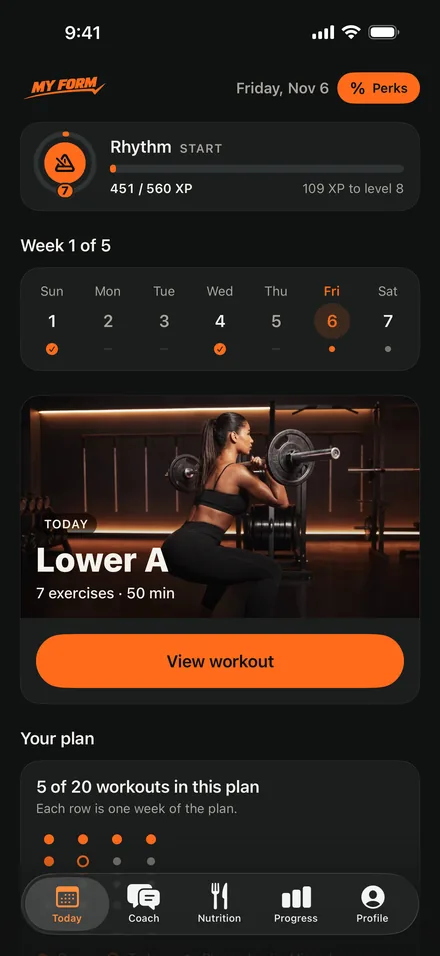
Open the Today screen and you see right away whether it's a workout or a rest day. If your schedule changes, you can change your goal, days, place or equipment, and your new plan starts the next Monday with your history kept.

My Form Today screen showing the level, the current week of the plan and today's workout

Frequently asked questions

What should I do if I miss a workout?

Don't try to cram two sessions into one day. Just pick up with the next workout in your plan and carry on. Missing one session now and then barely affects progress; what matters is that the weeks keep adding up.

How long should a workout plan last before I change it?

Stick with the same main exercises for at least four to six weeks. That's long enough to see whether your weights and reps are going up. After a block, you can swap some accessory exercises for variety while keeping the main lifts, so you can still compare your numbers.

Is a full body or a split routine better?

Neither is better on its own. The best choice is the one that matches how many days you can train consistently.

How do I know when to add weight?

Use a rep range. When you can do the top of the range on every set with good form, add a small amount of weight next session and start again from the bottom of the range. If you miss reps several sessions in a row, hold the weight or take a lighter week.

Get a workout plan built for your week

Tell the app your goal, experience, training days and equipment, and it builds your plan. 3 days free: trial for eligible new subscribers. Then from €7.99 a month or €49.99 a year; the App Store shows the price for your country.

Download on the App Store