
Guide

Home Workout: How to Train Without a Gym

Yes, a home workout can build real strength and fitness, even with no equipment at all. Your muscles don't know whether the resistance comes from a barbell, a resistance band or your own bodyweight. What matters is that the work is hard enough and gets a little harder over time.

The catch is that at home you can't just add another plate. You need other ways to progress, a routine that covers the whole body, and a bit of structure so "I'll work out later" actually happens. This guide covers all three.

Download on the App Store3 days free
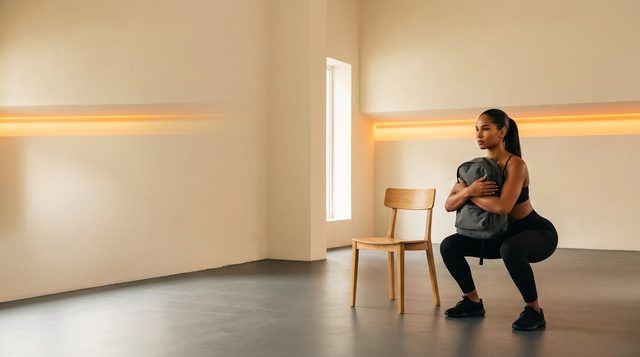
Woman in a bright room doing a squat while holding a weight at her chest, a chair beside her

What you need (and what you don't)

You can start with nothing but a few square feet of floor. Everyday items make it easier:

  • A sturdy chair or bench for step-ups, dips, Bulgarian split squats and incline push-ups
  • A wall for wall sits and handstand practice
  • A towel to slide on a smooth floor for hamstring curls and mountain climbers
  • A backpack loaded with books or water bottles as extra weight for squats and rows

If you want to invest in one thing, make it a resistance band. It's cheap, it fits in a drawer, and it finally gives you a way to train pulling movements like rows and face pulls, which bodyweight alone struggles to cover. Later, a pair of adjustable dumbbells or a kettlebell opens up even more options.

The movements a home workout should cover

Instead of picking random exercises, cover the basic movement patterns every session or every week:

  • Squat: bodyweight squat, goblet squat with a backpack, wall sit
  • Hinge: glute bridge, single-leg hip thrust, band good morning
  • Lunge: reverse lunge, step-up onto a chair, split squat
  • Push: push-up (from the wall, a table or the floor), pike push-up, chair dip
  • Pull: band row, band pull-apart, towel row in a doorframe
  • Core: plank, side plank, dead bug

A sample no-equipment routine

Do this as a circuit, two or three times a week, resting 60 to 90 seconds between rounds. Three to four rounds is a good target.

  • Squats: 12 to 20 reps
  • Push-ups (any variation): 6 to 15 reps
  • Reverse lunges: 8 to 12 per leg
  • Band or towel rows: 10 to 15 reps
  • Glute bridges: 12 to 20 reps
  • Plank: 20 to 45 seconds

How to keep progressing without heavier weights

This is where most home workouts stall. When an exercise gets easy, use one of these levers:

  • Add reps until you reach the top of your range.
  • Slow down. Take three or four seconds to lower into each squat or push-up. Same exercise, much harder.
  • Pause at the hardest point, like the bottom of a squat.
  • Switch to a harder variation: incline push-up to floor push-up, squat to split squat, glute bridge to single-leg bridge.
  • Use a tighter band or add load to your backpack.

Pick one lever at a time and keep a simple log, so you know what you did last week.

Making it a habit

Schedule your home workouts like appointments. Lay out your space and clothes the night before, and keep sessions short enough that you can't talk yourself out of them. Thirty focused minutes three times a week will take you further than one ambitious hour you only manage once a month.
How My Form plans your home workouts

When you set up My Form, you choose where you train: the gym, home with some gear of your own, or just bodyweight and a resistance band. Your plan follows that choice, and the home sessions make use of ordinary furniture and household items like the ones listed above.

  • 2 to 6 workouts a week, 30 to 75 minutes each
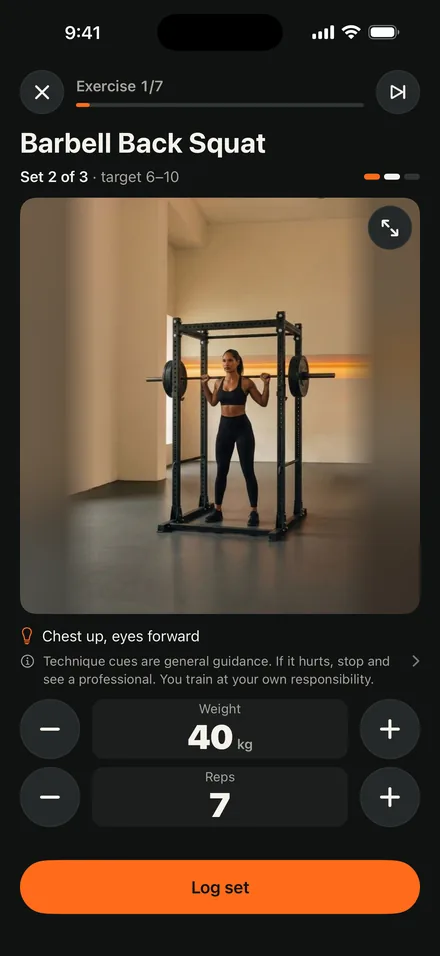
  • 118 exercises with photos, step-by-step instructions, a technique cue and the muscles worked
  • Set logging and a rest timer that starts on its own, plus a countdown for timed exercises like the plank
  • A short health check before your plan, so movements that would aggravate a sore knee, back or shoulder are left out

If you get access to a gym later, you can change your place and equipment, and your new plan starts the next Monday with your history kept.

My Form screen during a workout showing the current set, weight and reps

Frequently asked questions

Can you build muscle with home workouts?

Yes, as long as the exercises are challenging and you keep making them harder over time. Take your sets close to fatigue, use slower tempos and harder variations, and add a band or some weight when bodyweight gets easy. Eating enough protein and sleeping well matter at home just as much as in the gym.

How often should I do a home workout?

Two to four sessions a week works well for most people. Full body circuits two or three times a week are enough to see progress, with a rest day or a walk in between. If you train more often, alternate upper and lower body days so the same muscles get time to recover.

Is a resistance band workout as good as weights?

Bands load your muscles differently, with tension that rises as the band stretches, but they can still build strength very well. They are especially useful at home for rows and other pulling exercises. Many people combine bands with bodyweight work and add dumbbells later.

How long should a home workout be?

Thirty to forty-five minutes is enough for most home sessions, including a short warm-up. If you only have fifteen minutes, a quick circuit still counts. Consistency over weeks matters far more than the length of any single workout.

What if I have no space at all?

A space roughly the size of a yoga mat is enough for squats, lunges, push-ups, glute bridges and planks. Choose exercises that don't need jumping if you live above someone, and use slow tempos to make them harder without the noise.

Train at home with a real plan

Choose home with equipment or bodyweight and a resistance band, and get a plan built around it. 3 days free: trial for eligible new subscribers. Then from €7.99 a month or €49.99 a year; the App Store shows the price for your country.

Download on the App Store